martes, 9 de junio de 2020

Social Science 9th June 2020

Good morning, beautiful people:

How are you today? Fine? That's great.

I hope you liked our CSIC activities yesterday. Now you know how important Science is, let's do some Social Science.

Some days ago we said some things about the properties of minerals: colour (one or different colours), shape (cubical, hexagonal...) and hardness (from 0 to 10 on the Mohs Scale). 

1. Let's start with the next activity from your AB.

Next I'd like to start the new section, which is devoted to some of the uses of minerals and rocks (the things we can make with them).

If you read PB page 63 you can see some objects that are made with rocks and minerals.


2. After reading that information, write one use of the next rocks and minerals: 

LIMESTONE:
MARBLE:
ALUMINIUM:
DIAMONDS:

3. In the next video we can go over some of the contents about rocks and minerals we are studying, and also learn some new things.


4. Let's finish with an interactive worksheet (vais a ver que explica algunas cosas que ya sabéis, aunque puede que de un modo diferente. Leed la ficha y haced los ejercicios que ofrece a continuación). 


Minerals, una ficha interactiva de primaria4catalina
liveworksheets.com

lunes, 8 de junio de 2020

Visita al CSIC 8 de junio de 2020

Buenos días, amigos: 

¿Qué tal el fin de semana? Seguro que genial. Además, ya estamos a 8 de junio, el verano se acerca, el curso se acaba...¡todo son ventajas!

No lo sabíais, pero para este mes de junio teníamos concertada una visita al Centro de Ciencias Humanas y Sociales del CSIC. El CSIC es un centro de investigación en el que podemos encontrar biólogos, geólogos, arquéologos...  Aunque nos hemos perdido la visita, queríamos proponeros algunas actividades que pueden resultaros interesantes. Estamos seguros de que entre vosotros hay por lo menos un candidato a biólogo, una arquéologa, un químico, una botánica, etc. 

A ver qué os parece lo que os hemos preparado. 

Podemos comenzar con un repaso de algunas de las cosas que aprendimos en Social Science acerca de la Prehistoria.


Hemos hablado de fósiles en más de una ocasión, pero ¿cuánto podemos aprender a partir de los restos de animales y plantas que vivieron en nuestro planeta miles o millones de años atrás?


¿Sabes quién fue la primera mujer que recibió el Premio Nobel? o ¿quién investigó la evolución de las especies animales de nuestro planeta? En el siguiente enlace podéis aprender algo de algunos de los principales científicos de la historia. 


Hay personas que adoran los puzzles, ¿os atrevéis con alguno? Son puzzles con algunos científicos de los que aprenderéis mucho en los próximos cursos. 


En la página acerca de los científicos de más arriba, aparecen datos que puedes necesitar para la siguiente actividad que te proponemos...


Esperamos que os hayan gustado las actividades. Los científicos trabajan duro para hacer que nuestra sociedad mejore. Muchas de las cosas que tenemos a nuestro alrededor (el frigorífico, el motor de vuestro coche, este teléfono o tablet, nuestros alimentos bien conservados, el Dhalsy...) se las debemos a nuestros científicos. Y será un científico o una científica quien desarrolle la vacuna para el COVID19...¡Necesitamos científicos!

Un abrazo, amigos. 


Natural Science 4th June 2020

Good morning, my friends:

Before we start, there is something here I'd like you to read: click.

Welcome to a lovely Thursday. We are going to finish our invertebrates unit today with the last groups. 

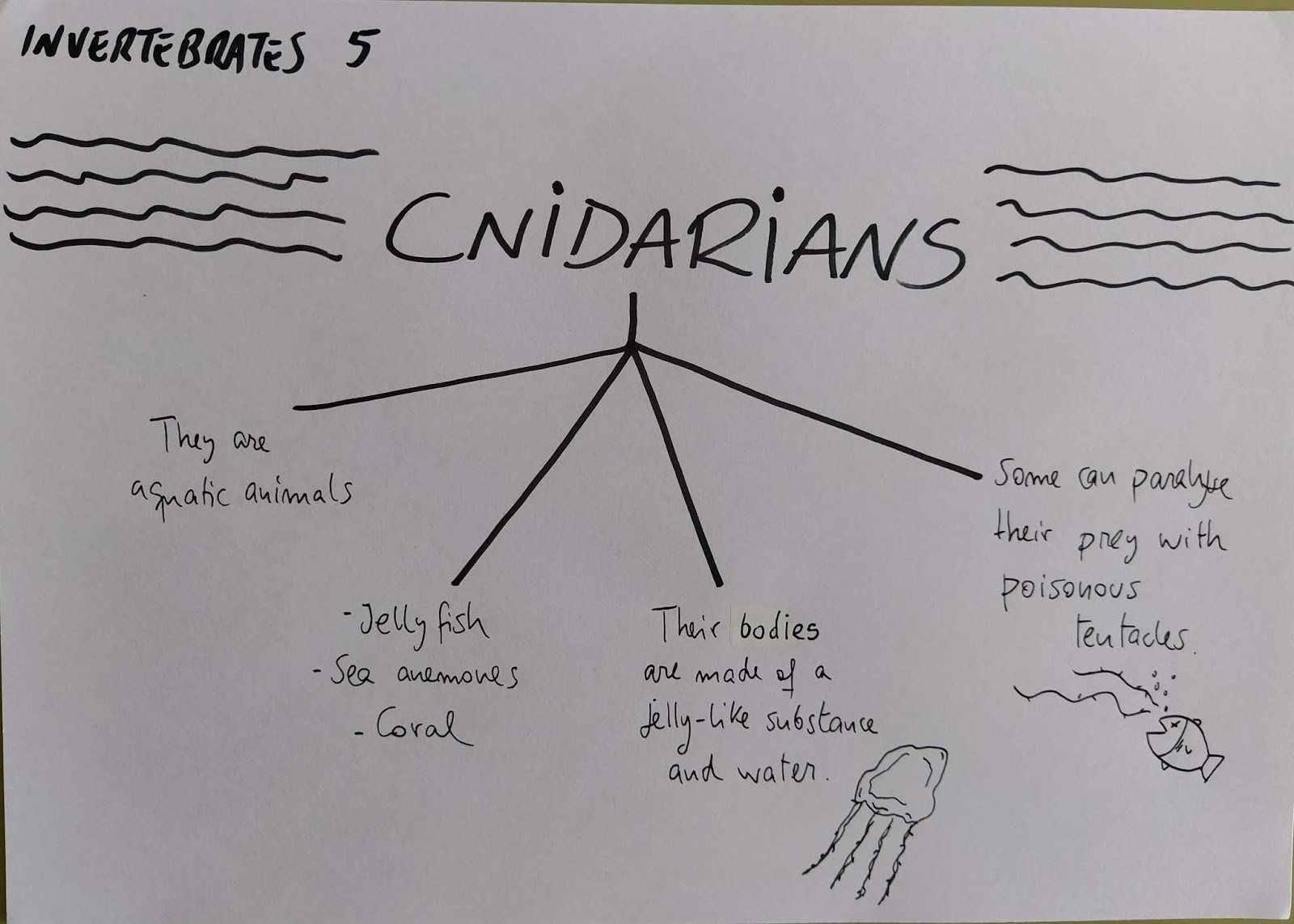
We started with arthropods, then we talked about molluscs and cnidarians. And today I'd like you to introduce you the annelids, cnidarians and sponges.

ANNELIDS


CNIDARIANS


SPONGES


After reading the information, try to answer the next questions (PB 47).

1. Why are annelids (earthworms) so important to the planet?
(you can find the answer on my word map, but the next video mentions it too). 


2. Which animal is the simplest animal on Earth? How do they eat?

3. What are the three different types of cnidarians?

4. Read these definitions and complete the next words about invertebrates:

a) Invertebrates which cannot move: s___________________
b) Arthropods with segmented bodies: m_________________
c) All animals with no backbone: i______________________
d) Arthropods which can have wings: i___________________
e) Animals which paralyse their prey with tentacles: c_________________


Let's finish with some interesting facts about jellyfish. I hope you like it!


See you tomorrow ;)

Ramón C. 

viernes, 5 de junio de 2020

Fin de semana 6-7 de junio de 2020

Hola, amigos: 

Ya van quedando pocos días para que acabe el curso y pronto lo escolar irá quedando en un segundo plano. Este año os habéis ganado las vacaciones más que nunca. Algunas de las entradas que he ido poniendo en el blog los fines de semana pretenden ser sugerencias de actividades para que aprendáis algo diferente y descubráis cosas nuevas. Estas entradas seguirán estando en el blog todo el verano por si algún día os apetece curiosear. 

Hoy me gustaría animaros a recrear objetos antiguos. ¿Os apetece?

1. La carta.
Seguramente recordéis que en el mural que hicimos de la vuelta al mundo, había algunas piezas de papel que parecían muy antiguas (quinientos años es mucho tiempo). 
Esto es lo que os propongo: 
- coge un folio (si tienes un sobre, haz lo mismo con él).
- escribe con boli una carta (puedes poner lo que quieras, pero tal vez podrías darle un toque misterioso: habla de un robo, un valioso objeto que desaparece...).
- cuando la tengas escrita, llama a un adulto y ved juntos el siguiente vídeo.


2. Las monedas.
Imagina que encuentras esa carta antigua y junto a la carta unas monedas. Seguramente esas monedas tengan un aspecto un tanto sucio, con un color verdoso... Tal vez podamos envejecer algunos de esos céntimos que tenemos por casa. En el siguiente vídeo te enseño cómo hacerlo.


3. La flor.
Ahora que estamos comenzando a salir más y, aprovechando que estamos en primavera, seguro que os encontráis con muchas flores en vuestros paseos. No os voy a pedir que arranquéis una flor, pero muchas veces algunas caen al suelo, y seguro que más de un pétalo ya está medio suelto... Pues eso. Coge una flor o un pétalo, con delicadeza colócalo entre dos hojas de papel y mete ese papel dentro de un diccionario o libro gordote que tengáis en casa. Dentro de una días, el pétalo se habrá secado y, si esperas unas semanas, su color será diferente.


¿Y ahora qué hacemos con todo esto? Pues no sé tú, pero yo veo el comienzo de una historia de misterio: unas monedas viejas, una carta antigua dentro de un sobre y unas flores secas... Y si no se te ocurre una historia, no pasa nada: al menos has aprendido a hacer algo que no sabías hace unas horas. Estaré encantado de ver algunas de tus creaciones :)

Un fuerte abrazo y feliz fin de semana.

Ramón C. 

English 5th June 2020

Good morning, little gastropods:

How are you today? It's Friday again! I can't believe how fast these days are happening. The thing is we have to do some English and, since it's Friday, we have to start with our little tradition. I have chosen a different song today. I hope you like it :)


1. Complete the lyrics (es muy larga, pero no tenemos ninguna prisa y además es divertidísima).

Be our guest
Be our guest
Put our service to the (1)_________________
Tie your napkin 'round your (2)_________________, cherie
And we provide the rest

Soup du jour
Hot hors d'oeuvres
Why, we only (3)________________to serve
Try the grey stuff, it's delicious
Don't (4)____________________me? Ask the dishes

They can sing
They can dance
After all, Miss, this is (5)___________________
And a (6)__________________here is never second best

Go on, unfold your menu
Take a glance and then you'll
Be our guest
Oui, our guest
Be our guest

Beef ragout
(7)__________________souffle
Pie and pudding "en flambe"
We'll prepare and serve with flair
A culinary cabaret
You're alone
And you're (8)______________________
But the banquet's all prepared
No one's gloomy or complaining
While the flatware's entertaining

We (9)____________jokes
I do tricks
With my fellow candlesticks
And it's all in (10)________________taste that you can bet

Come on and lift your glass
You've won your own free pass
To be out guest
If you're stressed
It's fine dining we suggest
Be our guest
Be our guest
Be our guest

(11)________________is so unnerving
For a servant who's not serving
He's not whole without a soul to wait upon
Ah, those good old (12)__________________when we were useful
Suddenly those good old days are gone
Ten (13)_______________we've been rusting
Needing so much more than dusting
Needing (14)_________________, a chance to use our skills
Most days we just lay around the castle
Flabby, fat and lazy
You walked in and oops-a-daisy!

It's a guest
It's a guest
Sakes alive, well I'll be blessed
Wine's been poured and thank the Lord
I've had the napkins freshly pressed
With dessert
She'll want (15)_______________________
And my dear that's fine with me
While the cups do their soft shoeing
I'll be bubbling, I'll be brewing

I'll get warm
Piping (16)_____________________
Heaven's sakes! Is that a spot?
Clean it up! We want the company impressed
We've got a lot to do
Is it one lump or two
For you, our guest
She's our guest
She's our guest
She's our guest

Be our guest
Be our guest
Our command is your request
It's ten years since we had anybody here
And we're obsessed

With your meal
With your ease
Yes, indeed, we aim to please
While the candlelight's still glowing
Let us help you
We'll keep going
Course by course
One by one
'Til you shout, enough, I'm done
Then we'll sing you off to sleep as you digest
Tonight you'll prop your feet up
But for now, let's (17)__________________up
Be our guest
Be our guest
Be our guest
Please, be our guest

2. In the link below we have a worksheet you can do to practise a bit more with the new structure we are learning (present perfect to talk about experiences we have had). 


3. The song was long and the worksheet was double, so I think you could use a break. Try the next game prepared by our friends from "Los Batanes" (los invertebrados de la Sierra de Guadarrama). 


Have a nice weekend ;)

Ramón C. 

miércoles, 3 de junio de 2020

English 3rd June 2020

Good morning, little mammals: 

How did you sleep last night? Any nightmares? No? That's great. Let's do some English today :)

As you know, in this unit we are learning how to talk about things you have done in the past. 

Let's start with a listening activity. On the link below you can listen to some kids talking about things they have done. Listen and choose the right options (aunque escuchéis que hablan de una tabla y de unas diferencias, vosotros limitaos a elegir las respuestas correctas).

1. Listen and choose the right option: a) or b).


KATHY

Has Kathy ever taken a photo?
a) Yes, she has. b) No, she hasn't.

Has Kathy ever bought a souvenir?
a) Yes, she has. b) No, she hasn't.

HELEN AND FRANK

Have Helen and Frank ever seen a whale?
a) Yes, they have. b) No, they haven't.

Have they ever seen dolphins?
a) Yes, they have. b) No, they haven't.

SOPHIA

Has Sophia ever played cricket?
a) Yes, she has. b) No, she hasn't.

OLIVER AND SARAH

Have Oliver and Sarah ever visited a monument?
a) Yes, they have. b) No, they haven't.

HOLLY

Has Holly ever eaten sushi?
a) Yes, she has. b) No, she hasn't.


2. Now try to complete the next sentences from the listening (you can listen to it again). 

a) Kathy hasn't______________a photo.
b) Sophia _________________ played cricket.
c) Oliver and Sarah_____________ played cricket.
d) Has Holly ever eaten sushi? Yes, she________________.
e) Have Oliver and Sarah ever eaten sushi? Yes, they______.

3. In this unit we are talking a lot about verbs. In the link below there is an easy worksheet where you have to identifiy the verbs (sometimes it's not that easy). 


4. After this hard work I think you desserve a nice quiz.


See you tomorrow :)

Ramón C. 


martes, 2 de junio de 2020

Social Science 2nd June 2020

Hello, little geologists!

(No olvidéis que hoy es martes poético: click).

I want to share today some pictures I received some days ago. A lovely cactus by David Me. and a cute kitten by Hugo R. 


We have to continue with our rocks and minerals, but first let's see if you can identify the next rock (a lovely photo sent by Daniela). Igneous, sedimentary or metamorphic?


Some days ago we talked about minerals and rocks. These are some of the things we learned: 

- Minerals are solid, natural and inorganic substances.
- Rocks are formed from minerals.
- There are three big groups of rocks: igneous, sedimentary and metamorphic.

1. To go over those contents, try the next exercise

a) This type of rock comes from lava____________________
b) Sometimes these rocks contain fossils_________________
c) These rocks change with extreme heat and pressure_____
d) Granite belongs to this group________________________
e) Clay belongs to this type of rocks_____________________
f) This is the external layer of our planet________________
g) A change in rocks produced by heat and pressure_______

2. Use your book to tell me where the different types of rocks can be found. Label the picture.


3. Do you know the difference between lava and magma? Is it the same?
_________________________________________________________________________________________________________________________________________________________


I'd like to introduce the new section: properties of minerals (PB 62). When we talk about the properties of minerals we are describing them. We talk about their colour, shape and hardness.

Have a look at the next word map. Next week we will do some activities about it. 


Hardness is one the properties: how hard a mineral is. In the next video you can see ten examples of minerals on the Mohs Scale, from the softest (talc) to the hardest (diamond). 


See you tomorrow ;)

Ramón C.