Mostrando entradas con la etiqueta invertebrates. Mostrar todas las entradas

martes, 15 de febrero de 2022

Natural Science: more invertebrates

Good morning, kids: 

I wanted to share with you two more word maps on invertebrates. This time we deal with molluscs and echinoderms. Have a look at them to see if you know that information. 

MOLLUSCS


ECHINODERMS


There are also two videos you could watch. They go over some aspects of those two groups. 


We finish with a game to go over some of those groups: GAME

See you tomorrow.

Ramón C. 

martes, 8 de febrero de 2022

Natural Science: Invertebrates

Hi, kids: 

I know some of you have troubles with invertebrates. They are a group with thousands of different species, so it is easy to be overwhelmed. I wanted to share with you a word map we used some time ago to study these contents. 

Let's start with arthropods (echad un vistazo al esquema y a ver si os suena lo que aparece en él). 


There is a game you can play to go over some of the contents you are studying about this group of crunchy animals. 

GAME

See you tomorrow!

Ramón C. 

jueves, 11 de junio de 2020

Natural Science 11th June 2020

Good morning, everyone:

How are you today? It's Thursday again...one of our last Thursdays! I'll try not to cry :(

Today I'd like to finish our unit about animals and start something new. 

1. In the next photographs, provided by our friends Lucas, we can see three different invertebrates. I want you to write: 
- its name, 
- its group (arthropod, mollusc, echinoderm, cnidarian, sponge, annelid), 
- one characteristic (body, where they live...).

INVERTEBRATE A.


INVERTEBRATE B


INVERTEBRATE C


Thank you, Lucas!

______________________________________________________________________________________________________

And now we have to start a new unit :)

Unit 6 is devoted to machines and energy. We studied some of these contents last year. 

Es una unidad que me hubiera gustado explicar en clase con diferentes objetos, ya que creo que este tipo de cosas solo se aprenden bien si podemos "manipular" algunas de esas herramientas. Es por ello que voy a seleccionar algunos contenidos que sí podemos aprender, aunque sea a distancia. 


If you have a look at PB pages 86-87 you can read some information about these simple machines. 


2. Think about the objects in your classroom or at home. Can you identify some simple machines? Write at least six:

LEVER_____________________________________________
INCLINED PLANE_____________________________________
PULLEY_____________________________________________
SCREW______________________________________________
WEDGE_____________________________________________
WHEEL AND AXLE

3. Let's finish with another interactive worksheet. Very easy, if you read it carefully ;)

See you tomorrow ;)


Simple machines, una ficha interactiva de SilviaBlanco
liveworksheets.com

lunes, 8 de junio de 2020

Natural Science 4th June 2020

Good morning, my friends:

Before we start, there is something here I'd like you to read: click.

Welcome to a lovely Thursday. We are going to finish our invertebrates unit today with the last groups. 

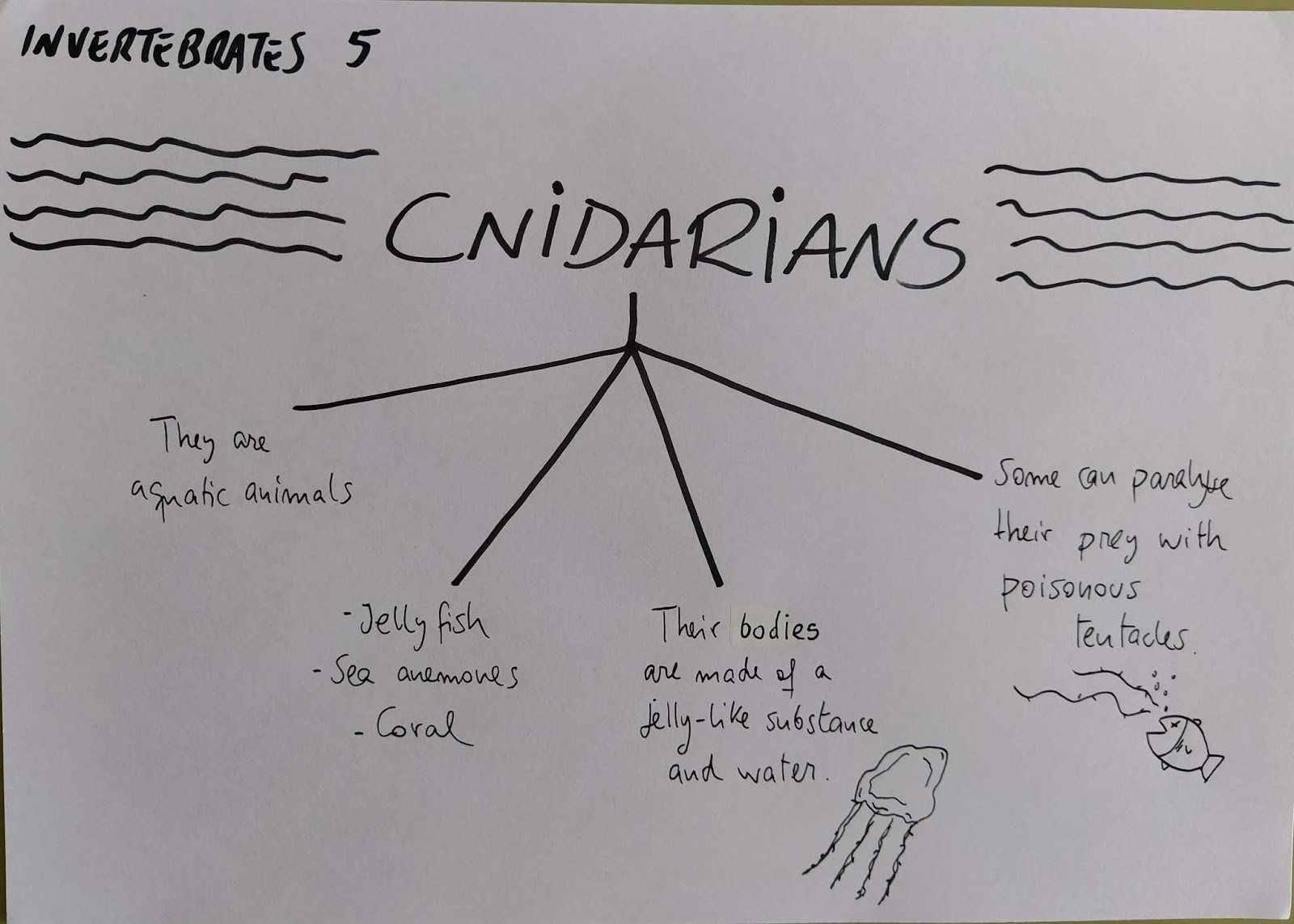
We started with arthropods, then we talked about molluscs and cnidarians. And today I'd like you to introduce you the annelids, cnidarians and sponges.

ANNELIDS


CNIDARIANS


SPONGES


After reading the information, try to answer the next questions (PB 47).

1. Why are annelids (earthworms) so important to the planet?
(you can find the answer on my word map, but the next video mentions it too). 


2. Which animal is the simplest animal on Earth? How do they eat?

3. What are the three different types of cnidarians?

4. Read these definitions and complete the next words about invertebrates:

a) Invertebrates which cannot move: s___________________
b) Arthropods with segmented bodies: m_________________
c) All animals with no backbone: i______________________
d) Arthropods which can have wings: i___________________
e) Animals which paralyse their prey with tentacles: c_________________


Let's finish with some interesting facts about jellyfish. I hope you like it!


See you tomorrow ;)

Ramón C. 

viernes, 29 de mayo de 2020

Natural Science 29th May 2020

Good morning, centipedes:

How are you today? It's Friday again and you know what that means. Yes, I know. But there's a problem. I usually share a song when we do English, but today we have Natural Science. So I thought: maybe I can choose a song about invertebrates. Not an easy thing! But I found one :)


Complete the lyrics below.

I'd like to be (1)___________the sea
In an octopus's garden in the shade
He'd let us in, knows (2)_____________we've been
In his octopus's garden in the shade

I'd ask my friends to (3)___________and see
An octopus's garden with me
I'd like to be under the sea
In an octopus's garden in the shade

We would be warm below the (4)_________________
In our little hideaway beneath the (5)______________
Resting our (6)______________on the sea bed
In an octopus's garden near a cave

We would (7)________________and dance around
Because we (8)____________we can't be found
I'd like to be under the sea
In an octopus's garden in the shade

We would shout and (9)_____________about
The (10)_____________that lies beneath the waves
(Lies beneath the ocean waves)
Oh what joy for every (11)___________and (12)_______________
Knowing they're happy and they're safe
(Happy and they're safe)

We would be so happy you and me
No one there to tell us what to do
I'd like to be under the sea
In an octopus's garden with you

And now let's continue with our invertebrates.

Some days ago we talked about the first group: Arthropods. It is the biggest group and it has four subgroups: insects, crustaceans, arachnids, cnidarians). 

Today we are going to see two new groups: molluscs and echinoderms. Have a look at the next word maps:


As you can see, it is a lot of information, but you don't have to learn everything. Read it carefully and try to do the next activities: 

1. How do cephalopods escape predators?

2. Identify the next molluscs and echinoderms:

a) I have a long, soft and elastic body___________________
b) I use my strong arms to open shells___________________
c) My soft body is protected by a shell___________________
d) I am a cephalopod but I am not an octopus____________
e) I have a spiky body_________________________________
f) I am a gastropod but I am not a snail__________________
g) I can use ink to escape predators_____________________


3. Let's finish with some AB exercises (AB 17).


I have found two videos about molluscs and echinoderms. I hope you like them. 

MOLLUSCS


ECHINODERMS (starfish)


Have a nice weekend!

Ramón C. 


lunes, 25 de mayo de 2020

Natural Science 25th May 2020

Hello, myriapods!

Echad un ojo antes de nada al blog de la biblioteca, que nos han saludado :) BLOG BIBLIOTECA

We start a new week with some Natural Science. I hope you had a nice weekend because today we have to work super hard. Oh, yeah!

It's time to talk about invertebrates. Most animals on Earth are invertebrates: incredible animals without backbone. Have a look at the next chart. It's incredible! 


There are millions of species of invertebrate animals. I am sure right now there are lots of them at home, next to you, maybe behind you... 

We are going to classify them in six groups. The next information can be found on PB page 45.


Today we are going to start with the first of those six groups: arthropods

Arthropods are the biggest group of invertebrates, and we can see four subgroups. Have a look (el esquema tiene más chicha de lo que parece. Os aconsejo que lo miréis tranquilamente y que me preguntéis si os surge alguna duda): 


In this unit we are going to learn a lot of things about these animals. It is important you read that information a few times, because I'm going to ask you about them in the next activities.

1. Let's start with an easy crossword (AB page 16).


2. In the next activity you have to write the correct group of arthropods: insects, crustaceans, arachnids or myriapods. If the sentence refers to the four groups, you write ARTHROPOD.

a) They have six legs__________________________________
b) They have a very thick exoskeleton___________________
c) They have a lot of legs______________________________
d) They can produce threads of silk_____________________
e) In some of them their two front legs are claws_________
f) They have eight legs________________________________
g) Some species have eight eyes________________________
h) They don't have a backbone_________________________
j) They only live on land______________________________
i) They lay egss______________________________________


3. Try the next easy game to go over some of the characteristics we have studied.


4. Next you can watch this video that offers a nice summary of some of the things we have seen today. 


5. Finally I want you to observe the next animal and tell me why it is not included in the group of arthropods. I thought it was an arthropod, so tell me why I am wrong (no me digáis que no es un artrópodo porque es un gato: con lo que ya sabéis de los artrópodos podéis decirme qué los caracteriza, y por qué no podéis incluir a este adorable animal en ese grupo).


Si os apetece, jugad a emparejar algunos de los insectos más comunes en la Sierra de Guadarrama. 

INSECTOS SIERRA DE GUADARRAMA

See you tomorrow :)

Ramón C.