sábado, 13 de junio de 2020

Fin de semana 13-14 de junio de 2020

Buenos días, amigos: 

Esta es la última entrada de fin de semana que tendremos en el blog. El próximo viernes acabamos el curso y es bueno que comencemos a buscar nuevas actividades y ocupaciones lejos de este blog que ha sido nuestra escuela virtual durante estos meses. 

Hoy os propongo algo diferente. En el mundo de las apps y de los juegos para móviles estáis mucho más al día que yo. De hecho creo que este es el primer juego que instalo. Se trata de una app protagonizada por Yeti, un pies grandes que nos acompaña en una expedición por el Himalaya. Si recorréis las montañas más altas del mundo con él, podréis aprender algunas cosas sobre el Everest. Creo que es interesante.

Es una aplicación gratuita que podéis instalar en móviles y tablets. 


En medio de esas montañas nevadas es posible encontrar animales. Tal vez os sorprenda algunas de las especies que podemos allí. 


Por si os apetece aprender algo más acerca del "techo del mundo", echad un vistazo al siguiente vídeo con ritmazo.


Un abrazo, chicos, y feliz fin de semana.

Ramón C. 

viernes, 12 de junio de 2020

English 12th June 2020

Hello, little people: 

It's our last Friday with "classes", because next week we have our video-call (jitsi). That means this could be our last song, or we could have another, maybe next week. I have to think about it :)

Anyway, let's start with some music ;)


1. Complete the lyrics:

Every drop of  (1)_____________________in that falls in Sahara Desert says it all
It's a miracle
All God's creations great and (2)________________________
The Golden Gate and the Taj Mahal
That's a miracle

Test tube babies being born
(3)__________________, fathers dead and gone
It's a miracle
We're having a miracle on earth
Mother nature does it all for us
The wonders of this (4)___________________go on
The Hanging Gardens of Babylon
Captain Cook and Cain and Abel
Jimi Hendrix to the (5)____________________of Babel
It's a miracle
It's a miracle
(It's a miracle)
It's a miracle
The one (6)________________we're all waiting for
Is peace on Earth and end to war
It's the miracle we need, the miracle
The miracle we're all waiting for (7)________________________
If every leaf on every (8)_____________________
Could tell a story that would be a miracle
If every child on every (9)_______________________
Had clothes to wear and (10)______________________to eat
That's a miracle
If all god's people could be free
To live in perfect harmony
It's a miracle
We're having a miracle on earth
Mother nature does it all for us
Open hearts and surgery
Sunday (11)___________________with a cup of tea
Super powers (12)_____________________fighting
Mona Lisa just keeps on smiling
It's a miracle
It's a miracle
It's a miracle
Well it's a miracle
It's a miracle
(It's a miracle)
It's a miracle
The one thing (the one thing)
We're all (13)___________________for (we're all waiting for)
Is peace on earth (peace on earth)
And an end to war (end to war)
It's the miracle we need, the (14)________________________
Peace on earth and end to war today

That time will come one day you'll see when we can all be friends
...


I hope you like it, I know Alvaro did. 

2. Two days ago we talked about Italy. Today we are going to read about another fantastic country: Mexico! You can read some information on PB page 99 (you can also listen to it on the link below).


3. After reading, try to answer the next questions about the text.

a) What can you eat in Mexico?
b) How old are some of the Ancient ruins in Mexico?
c) What are the typical music bands in Mexico?
d) Are there beaches in Mexico?

4. Let's finish today with another worksheet to go over Present perfect tense (very easy and short). 


Have a nice weekend :)

Ramón C. 

jueves, 11 de junio de 2020

Natural Science 11th June 2020

Good morning, everyone:

How are you today? It's Thursday again...one of our last Thursdays! I'll try not to cry :(

Today I'd like to finish our unit about animals and start something new. 

1. In the next photographs, provided by our friends Lucas, we can see three different invertebrates. I want you to write: 
- its name, 
- its group (arthropod, mollusc, echinoderm, cnidarian, sponge, annelid), 
- one characteristic (body, where they live...).

INVERTEBRATE A.


INVERTEBRATE B


INVERTEBRATE C


Thank you, Lucas!

______________________________________________________________________________________________________

And now we have to start a new unit :)

Unit 6 is devoted to machines and energy. We studied some of these contents last year. 

Es una unidad que me hubiera gustado explicar en clase con diferentes objetos, ya que creo que este tipo de cosas solo se aprenden bien si podemos "manipular" algunas de esas herramientas. Es por ello que voy a seleccionar algunos contenidos que sí podemos aprender, aunque sea a distancia. 


If you have a look at PB pages 86-87 you can read some information about these simple machines. 


2. Think about the objects in your classroom or at home. Can you identify some simple machines? Write at least six:

LEVER_____________________________________________
INCLINED PLANE_____________________________________
PULLEY_____________________________________________
SCREW______________________________________________
WEDGE_____________________________________________
WHEEL AND AXLE

3. Let's finish with another interactive worksheet. Very easy, if you read it carefully ;)

See you tomorrow ;)


Simple machines, una ficha interactiva de SilviaBlanco
liveworksheets.com

miércoles, 10 de junio de 2020

English 10th June 2020

Good morning, everyone:

Are you ready for some English? Today we are going to fly to Italy. It sounds good, doesn't it?

1. First read the next text from your PB page 98.


In case you don't have Navio, you can listen to it on the link below:


2. After reading the text, try to do the next activities about the text (AB 95:1-2). 


3. To practise with Present Perfect tense a bit more, try to answer the next questions:

a) Have you ever been to Italy?
b) Have you ever seen an active volcano?
c) Have you ever tried Italian ice cream?
d) Has your mother (she) ever visited Venice?
e) Has your teacher ever visited the Coliseum? (yes)
f) Have you ever seen Roman ruins?

4. This is not homework, but if you are interested in this fantastic country, you can learn some interesting facts about it on the link below.


See you tomorrow ;)

Ramón C. 


martes, 9 de junio de 2020

Social Science 9th June 2020

Good morning, beautiful people:

How are you today? Fine? That's great.

I hope you liked our CSIC activities yesterday. Now you know how important Science is, let's do some Social Science.

Some days ago we said some things about the properties of minerals: colour (one or different colours), shape (cubical, hexagonal...) and hardness (from 0 to 10 on the Mohs Scale). 

1. Let's start with the next activity from your AB.

Next I'd like to start the new section, which is devoted to some of the uses of minerals and rocks (the things we can make with them).

If you read PB page 63 you can see some objects that are made with rocks and minerals.


2. After reading that information, write one use of the next rocks and minerals: 

LIMESTONE:
MARBLE:
ALUMINIUM:
DIAMONDS:

3. In the next video we can go over some of the contents about rocks and minerals we are studying, and also learn some new things.


4. Let's finish with an interactive worksheet (vais a ver que explica algunas cosas que ya sabéis, aunque puede que de un modo diferente. Leed la ficha y haced los ejercicios que ofrece a continuación). 


Minerals, una ficha interactiva de primaria4catalina
liveworksheets.com

lunes, 8 de junio de 2020

Visita al CSIC 8 de junio de 2020

Buenos días, amigos: 

¿Qué tal el fin de semana? Seguro que genial. Además, ya estamos a 8 de junio, el verano se acerca, el curso se acaba...¡todo son ventajas!

No lo sabíais, pero para este mes de junio teníamos concertada una visita al Centro de Ciencias Humanas y Sociales del CSIC. El CSIC es un centro de investigación en el que podemos encontrar biólogos, geólogos, arquéologos...  Aunque nos hemos perdido la visita, queríamos proponeros algunas actividades que pueden resultaros interesantes. Estamos seguros de que entre vosotros hay por lo menos un candidato a biólogo, una arquéologa, un químico, una botánica, etc. 

A ver qué os parece lo que os hemos preparado. 

Podemos comenzar con un repaso de algunas de las cosas que aprendimos en Social Science acerca de la Prehistoria.


Hemos hablado de fósiles en más de una ocasión, pero ¿cuánto podemos aprender a partir de los restos de animales y plantas que vivieron en nuestro planeta miles o millones de años atrás?


¿Sabes quién fue la primera mujer que recibió el Premio Nobel? o ¿quién investigó la evolución de las especies animales de nuestro planeta? En el siguiente enlace podéis aprender algo de algunos de los principales científicos de la historia. 


Hay personas que adoran los puzzles, ¿os atrevéis con alguno? Son puzzles con algunos científicos de los que aprenderéis mucho en los próximos cursos. 


En la página acerca de los científicos de más arriba, aparecen datos que puedes necesitar para la siguiente actividad que te proponemos...


Esperamos que os hayan gustado las actividades. Los científicos trabajan duro para hacer que nuestra sociedad mejore. Muchas de las cosas que tenemos a nuestro alrededor (el frigorífico, el motor de vuestro coche, este teléfono o tablet, nuestros alimentos bien conservados, el Dhalsy...) se las debemos a nuestros científicos. Y será un científico o una científica quien desarrolle la vacuna para el COVID19...¡Necesitamos científicos!

Un abrazo, amigos. 


Natural Science 4th June 2020

Good morning, my friends:

Before we start, there is something here I'd like you to read: click.

Welcome to a lovely Thursday. We are going to finish our invertebrates unit today with the last groups. 

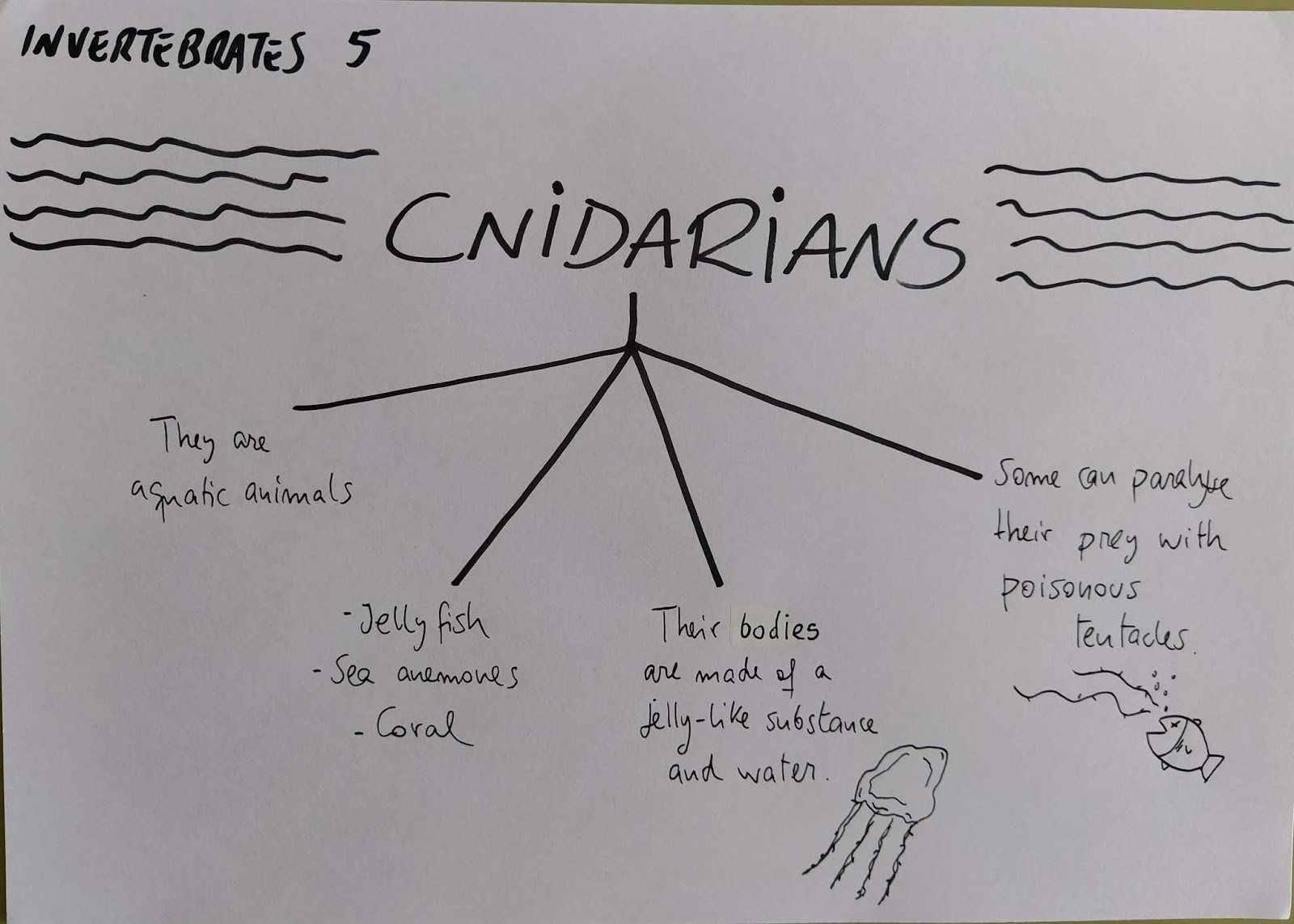
We started with arthropods, then we talked about molluscs and cnidarians. And today I'd like you to introduce you the annelids, cnidarians and sponges.

ANNELIDS


CNIDARIANS


SPONGES


After reading the information, try to answer the next questions (PB 47).

1. Why are annelids (earthworms) so important to the planet?
(you can find the answer on my word map, but the next video mentions it too). 


2. Which animal is the simplest animal on Earth? How do they eat?

3. What are the three different types of cnidarians?

4. Read these definitions and complete the next words about invertebrates:

a) Invertebrates which cannot move: s___________________
b) Arthropods with segmented bodies: m_________________
c) All animals with no backbone: i______________________
d) Arthropods which can have wings: i___________________
e) Animals which paralyse their prey with tentacles: c_________________


Let's finish with some interesting facts about jellyfish. I hope you like it!


See you tomorrow ;)

Ramón C.